 A few days ago I wrote The Dog That Didn't Bark. About the deliberate absence of feedback in recruitment. About a system that could explain its decisions but chooses not to, because explanation creates accountability. I did not expect to be writing a sequel quite so quickly.
In April I had an interview. It went well. The recruiter told me directly, at the end of it, that I would be moving forward to the next phase. I was pleased. I waited. And waited. And waited. Nineteen days. No update. No next steps. Nothing. I checked my application status online before I did anything else. Still showing as "In Review". So I emailed the recruiter to chase.
The recruiter, it turned out, didn't know what had happened either. She had to escalate to someone I had never spoken to. Within the hour, I had a rejection. With feedback. The feedback said this:
"After reviewing your portfolio of works, you showed genuine curiosity and a distinctive voice, but the work samples didn't demonstrate enough structural discipline or developer empathy needed to build a Cursor/Stripe-level ecosystem within this level of role."
Disappointing. But measured. A soft no that at least acknowledged something positive. But I didn't quite understand the "developer empathy" comment or the "structural discipline". I'm not going to say my work is faultless, but I just couldn't understand how they came up with that. At the end of the interview, the recruiter had asked me for a couple of links to things I had worked on. Not a portfolio. Not a curated body of work. Just a couple of links, literally grabbed on the spot after she asked. No context. Just "can you send me a couple of links to some content?". I hadn't prepared them. I hadn't presented them. I had typed them into an email and hit send. Calling that a portfolio of works felt like a stretch, but I let it go.
I should say something about how I approach situations like this. My other half will tell you, with some justification, that I have a tendency to be too fair. I give people the benefit of the doubt longer than most would. I assume mistakes before I assume malice. I let things slide because everybody gets things wrong and I would rather be generous than litigious. It is, apparently, a character flaw. But there is a limit. When someone pushes past it, something shifts. I stop absorbing and I start paying attention. Very careful attention.
I emailed back asking for a bit of clarification on the feedback because I couldn't quite get my head around what they were getting at and I wanted to understand. I waited a few days for a response. I got nothing. I felt that I had been entirely reasonable in requesting a bit more information and because they had clearly just ignored me, this tipped me over the edge. I started to pay attention. Very careful attention.
I raised a Subject Access Request under GDPR and asked for every piece of personal data they held about me. The idea being that if I could see the notes about me between individuals, I might be able to piece together the information I needed. What came back was revealing in ways I did not fully anticipate.
The data I received showed an entity (likely the hiring manager) who had, weeks earlier, been enthusiastic. They wanted me on the full interview track. A take-home assessment. An onsite. None of which I was ever given. It showed the recruiter's screening notes that seemed to be limited by comparison to what I remember talking about. They seemed to believe that I had tried to get funding for my EarthTunnelling.com project (I never came close to suggesting that and never have) and reduced twenty-five years of technical work to "building content is his main skill". OK, she didn't fully capture Richard Hall, but I do recall that during the interview she was dealing with kids running around. So I imagine it wasn't the best environment for her to capture everything (...see, I am tolerant).
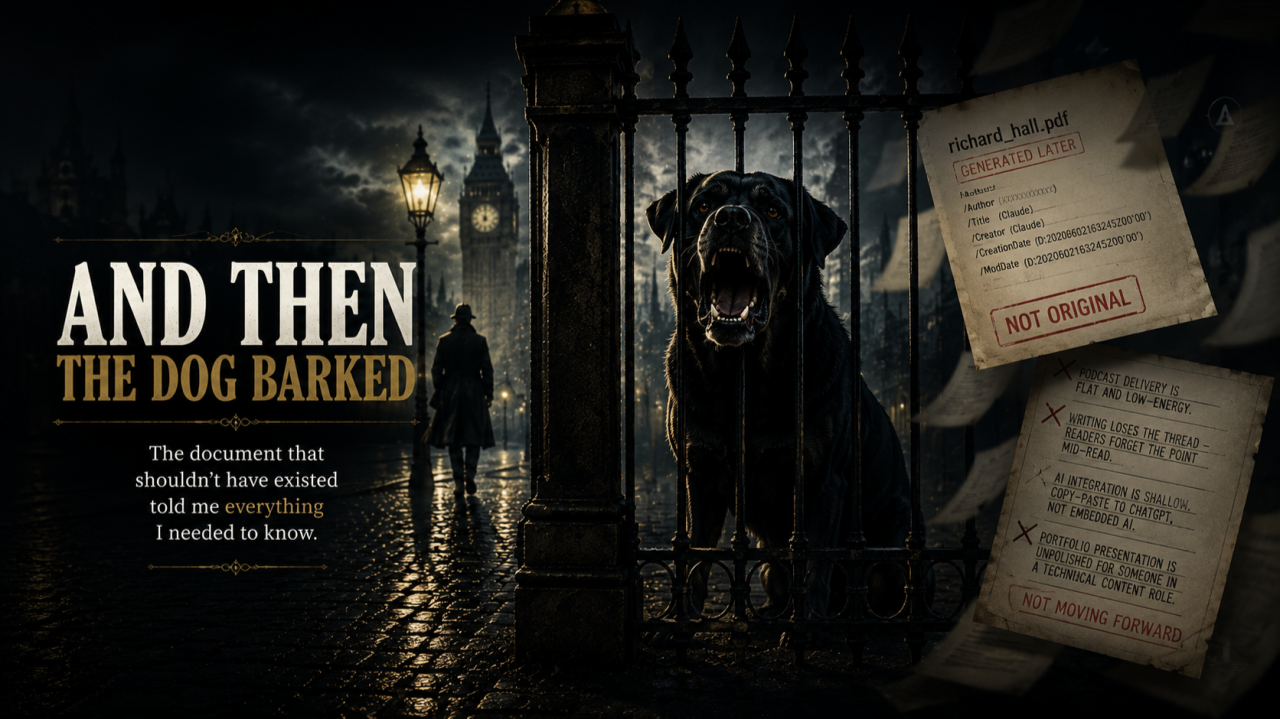
Then there was the content review document. The one that contained the specific criticisms of my work. The structured assessment with the "Not moving forward" recommendation. The internal email chain included in the SAR response referenced a document called richard_hall.pdf, shared internally on 15th April with the note "we reviewed Richard Hall's profile, here are the notes". That document existed. It was personal data I was entitled to receive. The richard_hall.pdf I was given was NOT that document.
PDF metadata is a small thing. Most people don't know it exists. It is written into the document's internal structure at the moment it is created and cannot be changed by copying or renaming a file. It is a receipt. The metadata in the document I received reads as follows (I've blanked the author's name, but it was the hiring manager):
/Author (XXXXXXXXXXX)
/Title (Claude)
/Creator (Claude)
/CreationDate (D:20260602163245Z00'00')
/ModDate (D:20260602163245Z00'00')
The document was created on 2nd June 2026. A couple of days ago. The identical creation and modification dates confirm it was produced in a single action and never subsequently edited. It was generated using Claude, Anthropic's AI platform. It was not authored by anyone in HR, legal, or data protection. It was authored by the hiring manager. The original richard_hall.pdf, the one that actually existed on 15th April, was not provided.
Now remember the original feedback. Genuine curiosity. Distinctive voice. A soft no. Here is what the retrospective document, produced a couple of days ago by the hiring manager using Claude, said instead:
Podcast delivery is flat and low-energy (...all 5 of us?)
Writing loses the thread badly enough that readers forget what the article is about mid-read (...reader, have you forgotten what this is about?)
AI integration is shallow. Copy-paste to ChatGPT, not embedded AI (...they obviously missed the section where I raised this as a money saving approach. APIs cost, pasting doesn't)
Portfolio presentation is unpolished for someone in a technical content role (...what portfolio? You were given links to different sources)
The same person who weeks earlier had said they liked me and wanted me on the full interview track had, after I raised a legal data request, produced a retrospective document to replace the original one (what did that contain that I couldn't be shown?) that systematically sought to dismantle my work from top to bottom. That shift in tone is not a coincidence. It is a tell.
But it was the portfolio criticism that I found particularly interesting. Remember, I had not given anyone a portfolio. I had typed a handful of links into an email at the recruiter's request at the end of the interview. Random links without any context suggested or requested. Just "some links". That was all.
The retrospective document did not just mention my portfolio in passing. It criticised its look and feel. That phrase is precise and it is telling. You cannot comment on the look and feel of a list of links in an email. Look and feel describes a website. A designed, navigable, visual thing.
My portfolio website did not exist until 27th April, two days before I was rejected and weeks after the review was supposed to have been written. I launched it publicly on that date and I can prove it independently. The hiring manager referenced a website that did not exist at the time of the supposed review, fed it into Claude, and produced a document criticising its look and feel, then submitted that document in response to a legal data protection request as though it were a contemporaneous (I'll admit, I used Claude to help draft my formal response to all of this. I liked that word) internal record. Also, I think we have to keep in mind that we have all used Claude, ChatGPT, and similar tools. They do not naturally leap to criticise and talk down content. They can, but you generally have to ask for that.
I want to be clear about what this means. The document presented as the basis for my rejection was produced a couple of days ago, by the hiring manager, using Claude, in response to my GDPR request, and submitted in place of the original document that was referenced in internal communications from April. The original remains missing. What was provided instead was a retrospective attack on my work, constructed after the fact, dressed up as an internal review.
Whether this is merely a catalogue of errors from a chaotic and broken hiring process or something that crosses into genuinely illegal territory is a question I have now put formally to the company's data protection team.
I am someone who knows how to investigate. I understand metadata. I understand what a PDF carries inside it that most people never think to check. I understood my GDPR rights and I exercised them methodically. Most candidates would have accepted the rejection, absorbed the criticism, and wondered what they did wrong. The feedback sent to me on 29th April was not designed to help me improve. It was designed to close a file. When I forced a paper trail into existence by demanding one, someone produced a far nastier document to fill a gap that should never have existed.
The dog that didn't bark told Holmes who the intruder was.
The document that shouldn't have existed told me everything I needed to know.
More to follow.