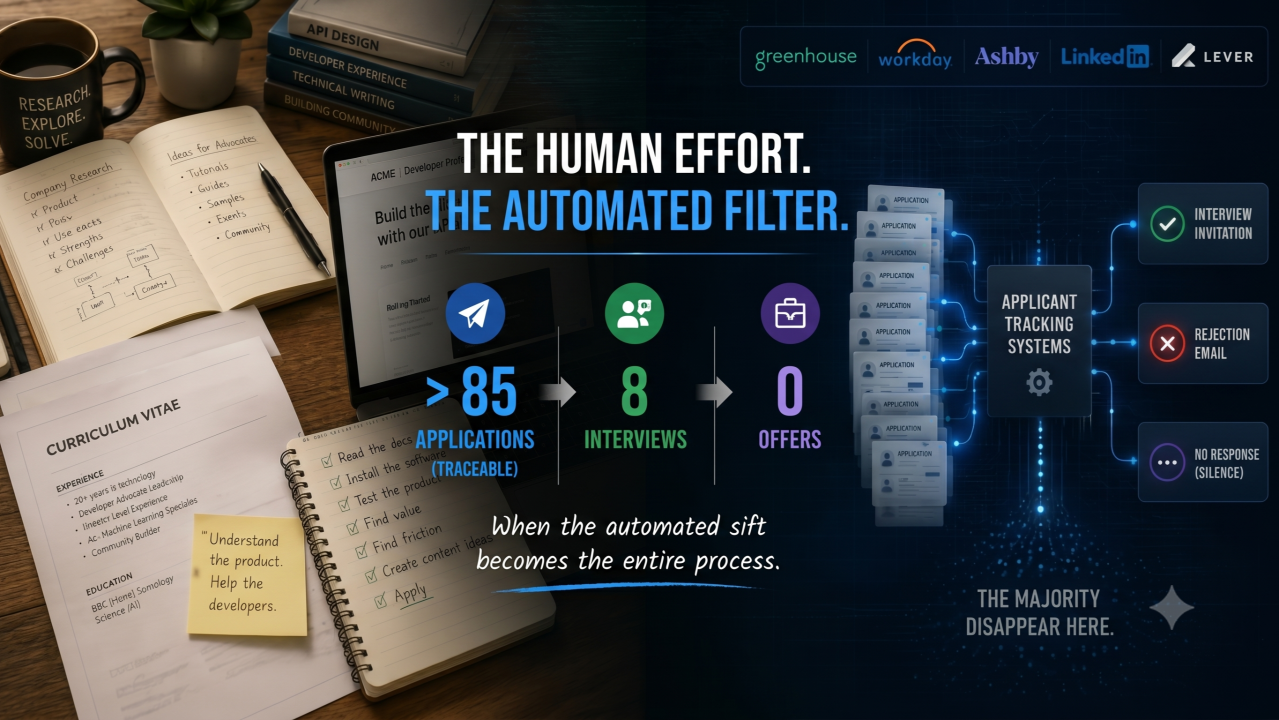
 I was playing around with Claude Cowork the other day and pointed it at my Gmail to see what it could do. The task? Reconstruct eighteen months of emails about job applications. Who I had applied to, when, what came back, how far each one got. I had tried this with Google Gemini a while back, expecting it to nail exactly this kind of thing. It really didn't. Cowork did. It built a timeline I would have lost a weekend assembling by hand, and it did it in about ten minutes.
It did miss a few bits and pieces. Threads it did not connect, applications it did not surface, outcomes it filed in the wrong place. That is not really the tool's fault. Searching a mailbox with a language model is not the same as querying a database. It can also only find what left a trace. Plenty of applications these days come back with nothing at all…you get no acknowledgement, no rejection, nothing, so there is nothing for any tool to find. More of them than you would think actually.
So, the numbers below are a floor, only what I could find. Here is what it found.
First of all, I feel I should acknowledge something that has been a personal choice. Some people will tell you they have sent a thousand applications. The data I have says that I have sent at least eighty-five, and I believe that to be about ¾ of the applications I have actually made. I do not let a model write my cover letters while I sleep. I do not scan jobsites for anything tenuously linked to what I do and have a model rewrite my CV to fit each one. For every one of the applications I have made I have researched the company, read the docs, installed the software (where possible) and used it. By the time I have applied to be a developer advocate or direct a team of developer advocates I could already do the job the role exists for. Pick up a product I did not know, find where it thrives and where it struggles, and come up with innovative content for the users of that product.
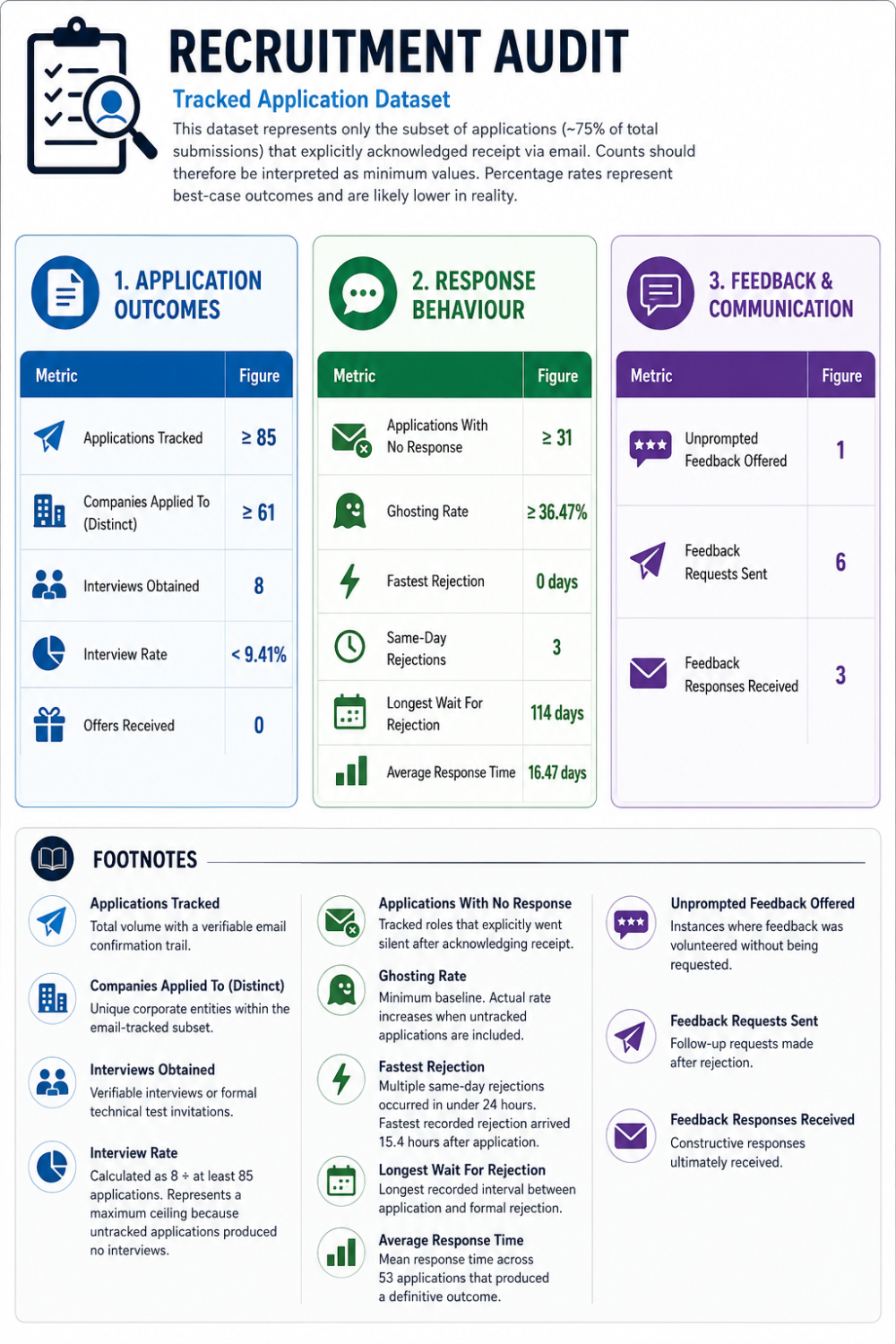
Eighty-five applications. Around fifty rejections, roughly thirty that went silent after acknowledging my application, eight that got to an interview, and no offers. By "went silent" I mean exactly that. They confirmed they had received my application and then nothing followed. No rejection, no request for an interview, just silence.
The eighty-five are only the ones that left a trace at all. The applications that vanished without even an acknowledgement are ghostings or auto-rejections by definition, they never reached a person…or a real person who felt like acknowledging my existence. This month alone two companies have so far said nothing back. My honest estimate of the real total is north of a hundred and ten. So, every figure here runs the same way. It undercounts the silence and the auto-rejections. It slightly overcounts how often I reached a person, because interviews leave a trail and silence does not. The real picture is worse than these numbers, not better.
To give you an idea of my background, I have over twenty years of experience. A first-class degree in computer science, specialising in AI. I was building neural networks when "AI" brought nothing but "Terminator" and "Skynet" to most people's minds. I have worked at director level and won company and department awards. For many years I was online in the UK until the last person in San Francisco had logged off. I am my own harshest critic, so I have spent a long time asking the obvious question before anyone else got the chance. I realise that I am not perfect and won't be top candidate for every role.
But I can't get my head around this question. What am I doing wrong?
The funnel fails before the interview, not during it
When I get in front of a person, I seldom fall at the first hurdle. One company took me through six rounds, screening, hiring manager, then three peer interviews, up to its chief marketing officer. Another ran me through five similar rounds ending with a vice president. Across the eight interview processes I reached, the average was around three interviews each. I do not fall apart under questioning. The places that put me in front of someone tended to keep me there, round after round, sometimes for weeks.
The failure is before any of that. Over 90% of my applications never produced a single conversation with a human. Rejected or ignored before anyone read or said a word.
Then there are the turnaround times, set out in full in the table below. The fastest no came back inside a working day. One company I had applied to at half past midnight turned me down seven hours after I woke in the morning. One firm I applied to three separate times rejected all three within two days each. Nobody reads a CV, weighs twenty years of work and writes back inside a few hours. A same-day rejection is not a decision about me. It is a keyword filter, or a location field, or a graduation year, or a model scoring a form, returning a no before a person is ever involved. That is most of what is happening here. The automated sift is not a support to human judgement, it is the entire process, and for the bulk of these roles human judgement never gets a look in.
Here is the eighteen months I've been searching in numbers. As already mentioned, these figures are only from the applications I could still reconstruct from my inbox, whether from an acknowledgement, a rejection, or some other trace. The real total is higher, and almost all of what is missing is pure silence, which means the table understates the silence more than anything else in it.
If you want to see the machine and the humans pulling in opposite directions, one company invited me to interview, and I booked a slot. Two days before it was due to happen, an automated rejection arrived. However, the interview wasn't cancelled. I had to email the person who had arranged it to ask which one was legit, the interview or the rejection. He came back the next day and confirmed the rejection stood. I'd managed to get through the lottery, but only after someone else had been made an offer. The system then forgot to cancel the interview.
This little exploration of the data revealed that there might be a pattern in where the silence comes from, and it is more obvious than I expected. Here I should note that I have a limited set of data. So any patterns spotted could very well be insignificant. But this is the only data I have.
I could sort every application into one of three routes. Most went through a mainstream applicant tracking system, the kind that parses your CV into boxes and scores it. Some I sent directly to the organisation, through their own form or an employee. And some went through the "Apply Via LinkedIn" button. Sixty-three went through a tracking system, fifteen went direct, and seven through LinkedIn. The tracking systems and the direct route produced exactly four interviews each. LinkedIn produced none. So the fifteen applications that skipped the machinery generated as many interviews as the sixty-three that went through it.
Then look at how the rejections arrived. Through the tracking systems, a no came back fast, a median of under a week, and sometimes the same day I applied. Through the non-system route, a rejection took a median of nearly two weeks. The slow no is the tell. It is the tell of a person actually weighing the application. The fast no is the tell of nobody weighing it at all.
And LinkedIn? It did not reject me and it did not interview me. Every single one of those seven applications simply vanished into silence. Not one rejection, not one acknowledgement, nothing. Applying there was indistinguishable from not applying at all.
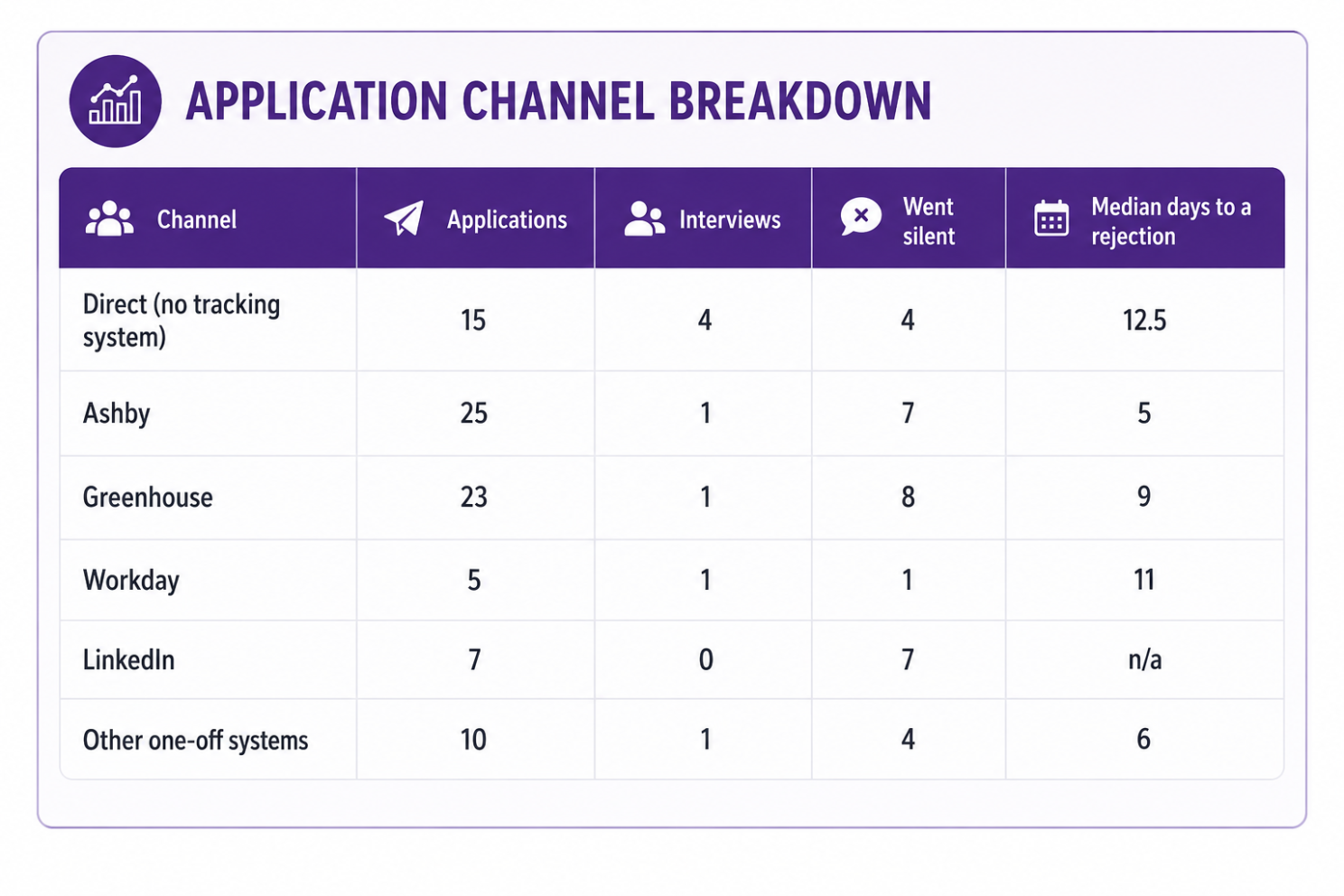
The lesson is not subtle. First of all, forget the "Apply Via LinkedIn" button. Forgetting that, reaching a human was rarest through the systems built to filter out people before a human gets involved. The route that worked best was the one that never touched a tracking system at all.
What this is not
The internet is full of people explaining their job search through the most flattering lens going, and I would rather not be one of them. This is not one of those pieces.
Many of the roles I have applied for were in the United States. I am in the UK. I did not ignore that. I only applied to US roles advertised as remote, and for each one I checked that it did not need US residency or relocation. I was not firing off applications to onsite San Francisco jobs and then acting wounded when they passed. Where geography could have been the reason, I took it off the table before applying. The market has also contracted hard over the last two years. Fewer seats and more people standing. A bit like my old commutes on the London Underground. Also, it should be acknowledged that some rejections will have just been down to a closer fit elsewhere, someone whose recent work sat dead centre of the niche where mine was maybe a bit broader. Fair enough. I can fully understand that.
Then there is volume. Eighty-five (or 113 if we factor in the guesstimate of applications) over about 18 months is about 1.5 a week, and the standard advice is that I should apply to more and loosen my requirements. The thing people forget is that there is no endless supply of suitable, genuinely open positions to spray applications at. The pool is finite, and I have worked through it steadily. Some weeks there are absolutely no new roles that come up, other weeks there are 3 or 4.
There is also a deeper version of the loosen-up advice, and I have thought about it more than the people giving it. I have not been applying to roles I would walk away from the second something better came along. There is no point. It does not help me and it does not help the employer who onboards someone who is already half gone before they start. I want a role I can commit to, one that lasts longer than it would take me to find the next one. Taking a job where you plan to keep job-hunting from before you start, helps nobody. So I don't do that.
What I have done is lower the bar where it actually makes sense. I am no longer only applying at the level I last worked at. I started like that and the rate of roles coming up was incredibly slow. I am applying at that level and several below it. The one thing I have held onto is that I have to be interested in the product I would be working with. That is my whole list of requirements. If what the "loosening the list" people had in mind was seniority or money, I loosened those requirements a long time ago. The bit I won't loosen is ensuring my suitability to the role and the role's suitability to me. Imposter syndrome (which this process is not helping at all) means I am doing the recruiters' filtering for them, on myself, before I even apply. If I apply, I'm a bloody good fit for the role. But lets look at some of the experiences I’ve had where I have met with humans.
Rejections that had to misrepresent me to work
After a couple of rounds with one company I did get some unprompted feedback. Just once in the whole period. Apparently they were going with candidates whose focus matched their B2B landscape better, given my "passion for driving B2C-forward strategies and engaging with broad consumer audiences".
I have no such passion. The only thing I said about consumer marketing in my meeting with the hiring manager, was one example. That a company with strong B2C brand pull like Apple can use it to drive B2B adoption, and that I would bet a fair number of their own staff had asked for Macs because of this. That is a B2B point. It uses a consumer brand to explain enterprise buying. The rejection took that, turned it into a consumer-marketing "aspiration" I do not have, and turned me down for a 30 second comment in an hour interview. It then suggested I keep an eye on their Marketing and Product Management roles, which was a strange thing to recommend to someone they had just decided was too focused on the wrong kind of marketing.
The company that took me through six rounds all the way up to its CMO was interesting. I had worked in the marketing department of a company where this CMO was the CMO before I started there. We knew people in common from the team and discussed the team we had both worked with during the interview. After the final round it went very quiet. So, I chased up. I was told that they had gone with another candidate. Nothing else. I asked for feedback. Nothing. I chased again two weeks later. Three weeks after the rejection, what came back was that the team had been impressed with my technical depth, but I didn't have a background in marketing. I didn't have a background in marketing…yet a big chunk of the discussion with the CMO was about my background with a marketing team he had built.
I am not naming these companies. This is not about settling scores. It is about the experiences. When the stated reasons for a rejection are not just wrong but have to misquote you or just lie to work, they are not the real reasons. They are stories put together afterwards to cover decisions made on grounds nobody wrote down or wanted to write down.
The ones that gave no reason at all
Then there are the organisations that give you no feedback after taking hours of your time…even when you ask.
One took me through three rounds, up to a vice president, then closed with a template. Thanking me for my time, that they had a lot of applicants and that they had gone with another candidate. I noticed about a week ago that they have just taken on someone for the role. If they were working out their notice before starting, 8 months is a LONG notice period.
A really early one in the process had me do a technical exercise after an interview with the recruiter and then the hiring manager. The exercise was to build a game with a basic "Top Trumps" API they had written, write a full documentation for the API and the game (a website), then write a full blog about the process. I did all of that in a couple of days. Silence.
I waited a couple of weeks and then I chased for an outcome. I got an invitation to a meeting and I believed that this would be either an offer or another interview…it wasn't clear. I was then presented with an internal recruiter I’d not met before who told me that I was not moving forward. I was a bit shocked and asked why. He said "We went with someone else". I asked whether the content I put together was the problem. He said that he didn't know. Was there ANY feedback at all? He flicked through the app he was using and said "I'm sorry, this is not one of my roles. The recruiter handling this one is on holiday". So I asked whether my work was assessed by the recruiter or the hiring manager and was there not something about that in the file. No was the answer. Now, I will admit my professional guard slipped a little here. But consider what had just happened. I had built a working game, full documentation for both the game and its API, and a blog about the whole process, several days of real work, and it had been met with a shrug and a recruiter who could not even find the file. I let my frustration show. I kick myself for allowing that, but after that kind of contempt, I think many people would have been equally annoyed.
In eighteen months and at least eighty-five applications, exactly one company gave me feedback without being chased for it, and that was feedback that was the equivalent of improvisational dance. Every time an interview ended in a rejection with no explanation, I asked for one. That is just what I do. Of the ones I asked for, three got an answer. The rest, including companies that had taken me through several rounds, said nothing at all. They ignored my email. None of what did come back was anything I could actually use to refine my approach (apart from not making comments about B2C marketing).
I am not raising this as a complaint about ethics or manners, though they are non-existent from my experience. The failure modes together tell you the shape of it. Sometimes the process invents a reason it cannot stand behind. Sometimes it gives no reason at all, even after pulling real work out of you. Either way the actual basis for the decision never gets written down, and you are left to guess. Imagine how frustrating that is.
The thing about a young discipline
Developer advocacy/relations as an AI-flavoured discipline is only a few years old. A lot of the roles I applied for are explicitly AI developer advocate jobs, in a field that cannot have veterans yet, because it has not existed long enough to produce any.
So, it staffs itself with the only people who fit a "native to this world" framing, the ones whose whole short career sits inside it. Nothing wrong with those people. But the framing quietly turns "qualified" into "as young as the new thing and willing to learn", and the people who built and specialised in the older disciplines it stands on are seen as the wrong fit. The integration, the APIs, the data plumbing, the workflow automation that agentic AI is assembled out of, none of it counts as a requirement. Why? Because when recruiters and hiring managers think "agentic", they do not understand the groundwork it stands on.
I could explain these technologies in my sleep. I have spent my career on the work this wave is built on top of. Yet I get rejected, sometimes the same day I apply, by a process that never lets me reach the part where I would do exactly that, comfortably, and in front of an audience.
The question I will leave you with
I am not going to claim I can prove why this is happening. The real reasons never get written down, which is clearly the point of a rejection email that misquotes you. I can show you the reasons are manufactured. I cannot show you, from the outside, what they were manufactured to hide.
What I can do is put the facts down and let you sit with them. Because this is doing something to the people caught in this situation that the recruitment world fails to acknowledge.
Everything I set out at the start. The experience, the credentials, the decades spent on the foundations the new agentic AI field now rests on. Fewer applications than the people sending thousands, every one researched, every product actually used before applying. Never dropped the ball, online until the West Coast went home. That's what I bring.
Well over eighty-five applications. Of those, eight reached a person. The rest, over ninety per cent, were turned down before anyone had a conversation with me. If you read the recent LinkedIn posts from many recruiters, you will see them complaining that candidates cause the problem by using AI to spam them with applications. So what exactly am I being trained to do here? I have done the opposite of spamming, and it has got me nowhere. I am NOT firing AI-written applications at companies by the hundred. But should I be??